
TL; DR
A new Lippincott study says CMOs are trading long-term brand building for short-term wins to earn respect in the C-suite—and only 28% feel they have real organizational influence.
Everyone’s reading that as a short-term-versus-long-term problem. It isn’t. CMOs aren’t losing influence because they’re too short-term. They’re losing it because they’re managing channels instead of running a system.
The data is the symptom. The missing operating system is the cause. Here’s the difference—and how the PESO Model® fixes it.
Key Insights:
- Only 28% of CMOs say they have a “very high” level of organizational influence; 84% say aligning leadership around a shared marketing vision is difficult; and nearly 80% say bureaucracy regularly gets in the way of decision-making. That’s not a confidence problem. It’s a structural one.
- The short- vs. long-term debate is a trap. You cannot win a long-term brand argument inside a quarterly-results room—so stop choosing sides and run a system that produces near-term proof and compounding authority at the same time.
- CMOs are pouring budget into AI while pulling money away from the owned infrastructure—UX, mobile, loyalty, content—that actually protects them from AI disruption. Only 12% rate their tech enablement “excellent.”
- That underfunded owned infrastructure is exactly what determines whether your brand shows up in ChatGPT, Gemini, and Perplexity answers. Starve it, and you disappear from the place where buyers now start their search.
- Visibility engineering—building owned media that both humans and machines can find, trust, and cite—is the fix the study describes without naming.
- The PESO Model® isn’t four channels you run in parallel. It’s an operating system: owned as the source of truth, earned as proof, shared as distribution and intelligence, paid as amplification, integration as the connective layer, and measurement as the thing that earns C-suite respect back.
- The influence problem and the integration problem are the same problem. Solve one, and you’ve solved the other.
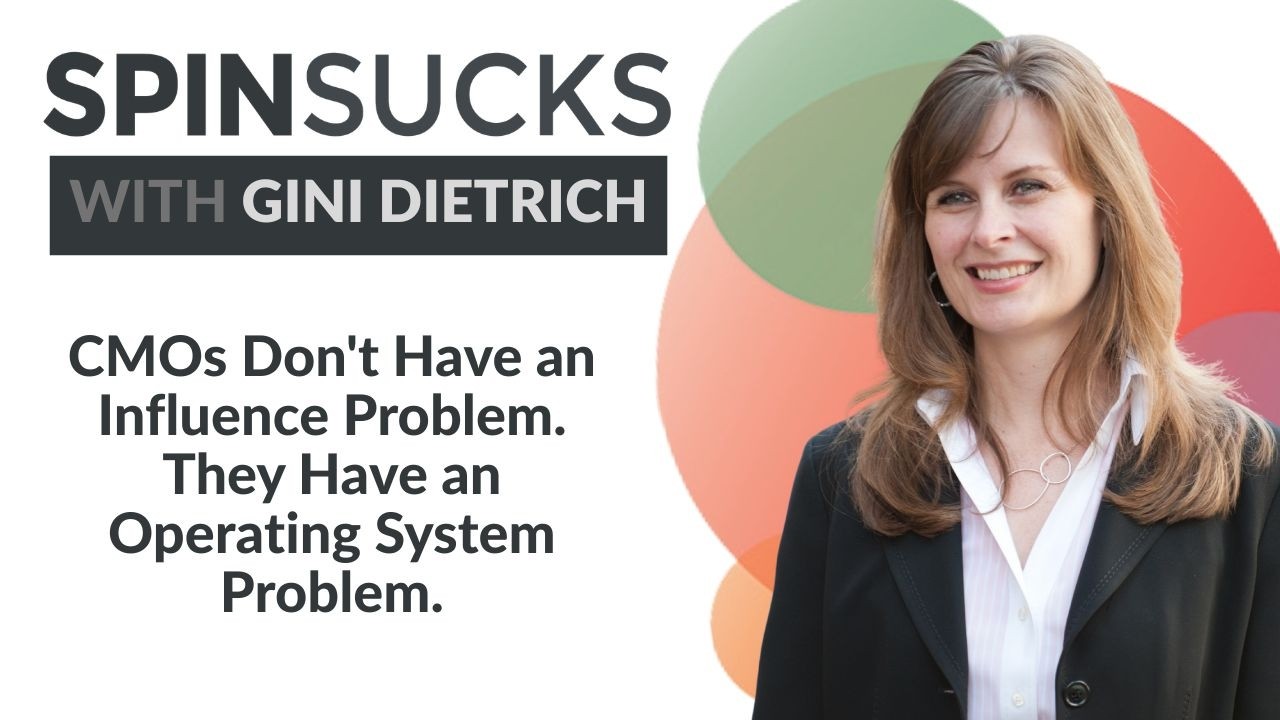
CMOs Don’t Have an Influence Problem. They Have an Operating System Problem.
Last week, Lippincott published its “CMO Outlook 2026” study, and it was rough. If you’re a CMO—or you report to one—it probably reads like a disturbing diagnosis of your own work.
Here’s the gist.
Under pressure from CEOs, marketing leaders are choosing short-term results over long-term brand building, mostly to earn credibility in the C-suite. Ug.
Only 28% feel they have a “very high” level of organizational influence. Eighty-four percent say it’s hard to align leadership around a shared marketing vision. Nearly 80% say bureaucracy regularly interferes with decision-making. Fewer than half feel marketing operates with any real autonomy. And 15% say they aren’t even the top marketing decision-maker in their own organization.
The CMO. Not the top marketing decision maker!
Phew.
If you felt a little seen—or a little sad—reading that, you’re not alone.
At least 541 CMOs on four continents are with you.
But here’s where I’m going to part ways with how everyone else is reading it.
The headlines say CMOs are losing influence because they’ve gone too short-term—that they’ve traded the brand-building that earns long-term respect for the quick wins that keep them employed this quarter.
The implied fix is, “Be braver. Make the long-term case. Win the room.”
Sure, you can’t abandon long-term results for short-term wins, but I don’t think that’s the problem at all.
CMOs aren’t losing influence because they’re too short-term. They’re losing it because they’re managing channels instead of running a system.
The Lippincott data is the symptom. The missing operating system is the cause.
The Short vs. Long-Term Debate is a Trap
Every think piece about this study wants to relitigate the same fight: brand versus performance, long- vs. short-term, the 60/40 rule versus this quarter’s pipeline.
It’s a trap. And we all keep walking into it.
You cannot win a long-term brand argument inside a quarterly results room. The CEO who’s getting squeezed by the board doesn’t want to hear about brand equity compounding over three years.
They want to know what marketing did to increase revenue in the last 11 days.
So the CMO who shows up to that meeting armed with a beautiful long-term brand case loses. Not because the case is wrong, but because it’s the wrong instrument for the room.
And the CMO who caves and goes all-in on short-term performance loses, too. That loss is slower, but a loss just the same.
Performance with no brand behind it gets more expensive every quarter, and eventually, you’re the person explaining why customer acquisition costs keep climbing.
So both sides of the debate lead to the same place: a marketing leader with no influence.
The way out isn’t to choose a side. It’s to stop choosing.
The CMOs who actually have influence aren’t winning the brand-versus-performance argument. They’ve made it irrelevant.
They run a system that produces near-term proof and compounding authority from the same set of activities. They walk into the quarterly results room with this quarter’s number and the asset that will make next quarter’s number cheaper.
Same work. Two payoffs.
That’s not a personality trait. It’s not “executive presence.”
It’s an operating model. And most marketing departments don’t have one.
They Are Managing Channels Instead
Think about how a typical marketing org is built. There’s a content person. A PR person or agency. A social team. A paid media manager. A demand gen lead. An events coordinator. Maybe an SEO specialist hanging on for dear life.
Every one of them is busy. Every one of them is producing. And almost none of it connects.
The blog post doesn’t reference the research the PR team just placed. The webinar doesn’t feed the paid campaign. The earned media placement lives and dies in a coverage report nobody reads. The social team is reacting to a trend the brand has no actual point of view on.
Everyone’s working hard, and the whole thing produces a fraction of what it should, because nothing compounds.
This is what 84% “it’s hard to align leadership around a shared vision” actually looks like on the ground.
It’s not that the CMO can’t write a vision statement. It’s that there’s no system underneath the vision to make the pieces pull in the same direction.
Without a system, “alignment” is just a meeting. With an operating system, it’s how the work compounds and works while you sleep.
When you manage channels rather than run a system, you can’t prove your value, because value lies in the connections between channels, not in any single one.
So you get the 28%. You get the bureaucracy. You get the 15% who aren’t in charge of their own function anymore.
Not because they’re bad at their jobs, but because they can’t show the C-suite a machine. They can only show the C-suite a to-do list.
You don’t earn influence by working harder inside a broken structure. You earn it by replacing the structure.
The AI Contradiction Nobody’s Talking About
And yet, CMOs are funneling investment into AI—as they should—while diverting funds from user experience, mobile apps, and loyalty.
The study frames that as starving the infrastructure that protects you from AI disruption. Which is true.
But it’s also worse than that.
The owned infrastructure you’re defunding—your website, your content, your structured data, your actual published expertise—is the exact thing that determines whether your brand shows up inside AI answers.
When a buyer asks AI, “Who’s the best at X?” the model answers based on what it can find, what it trusts, and what it cites. And what it finds is owned media. Earned media. Shared media.
The stuff a real, recognized brand has published and said about it across the web.
If you’ve spent the last year cutting that to fund an AI initiative, you’ve done something genuinely backward: you’ve invested in AI in a way that makes you less visible inside AI.
Only 12% of CMOs rate their tech enablement “excellent.” Only 11% say their organization is excellent at adopting new technology.
So most of this AI spend is landing in organizations that aren’t structurally ready to use it, and is being paid for by gutting the one asset that earns visibility in the channel they’re chasing.
That’s not a budget problem. That’s an operating system problem. A company running a marketing operating system would never make this trade, because it would see that owned media isn’t a cost center to raid—it’s the source of truth everything else depends on, including the AI bet.
That’s what visibility engineering is built to fix. Building owned media that both humans and machines can find, trust, and cite—so that when the search happens, on Google or inside an LLM, you’re the answer.
It’s the long-term brand play and the get-found-today play, fused. Which is exactly the kind of two-payoff move a CMO with influence makes.
The PESO Model® is the Operating System
So if the problem is a missing operating system, you probably already know what you’re missing.
It’s the PESO Model®—paid, earned, shared, and owned media—and the reason it solves the influence problem is that it was never meant to be four channels you run side by side.
It’s a system, and the system is what’s going to save you, both short- and long-term.
Owned is the Source of Truth
Everything starts here. Owned is your foundation. Your source of truth.
Your content, your research, your point of view, your site. It’s the asset you control, the thing AI cites, and the place where near-term proof (a piece that converts this week) and long-term authority (a body of work that compounds for years) are literally the same artifact.
Defund this, and the whole system loses its center, which is precisely the mistake the study caught CMOs making.
Earned is Proof
Third-party credibility—media coverage, analyst mentions, the expert quoted in the trade media, a newsletter mention, a review, a podcast appearance. This is all considered the proof layer.
It’s what makes the owned media believable and what teaches the AI models that your brand is one worth citing.
Earned media without owned media to point back to evaporates. Owned without earned looks like marketing.
Together, they look like authority.
Shared is Distribution and Intelligence
Social isn’t a megaphone bolted on. It’s how owned and earned get distributed. We’re also learning more and more every day about how LLMs learn, and some social media (Reddit and LinkedIn newsletters, for instance) is as important as earned and owned media.
It also helps you understand what your audience cares about, so your next owned media asset is sharper.
It’s a two-way channel. Most orgs only use it in one direction, which is why their social feels like noise and why it typically doesn’t result in much.
Paid is Amplification
Paid is the accelerant, not the engine.
You put money behind the owned, earned, and shared that’s already working—to make it go faster and reach further.
When paid is the strategy, you’re renting attention you’ll lose the second the budget stops. When paid amplifies a system, you’re compounding something you own.
Integration is the Connective Layer
Integration is what turns four channels into one system: the earned media placement that drives to the owned media asset on your website, which is shared and amplified by paid, all organized around a single thesis.
This is the layer that produces the “alignment” 84% of CMOs say they can’t get.
You don’t align people with a vision statement.
You align them with a system that makes the connections obvious.
Measurement is How You Earn Respect Back
And here’s how you walk back into the quarterly results room.
When the channels are integrated, you can measure the whole machine—not “the blog got X views” but “this thesis, run through the full system, produced this pipeline and this authority.”
You can show near-term proof and long-term compounding in the same report.
That’s what earns influence back.
Not a braver argument. A better instrument.
Look at that list again and then look at the Lippincott findings. Low influence. No alignment. Can’t prove value. Defunding the wrong things.
Every single one is what happens when you run channels without a system. The influence problem and the integration problem are the same problem.
Which is good news—because it means you only have to solve one.
So What Do You Actually Do?
Stop trying to win the brand-versus-performance debate. You can’t, and it’s costing you the room.
Start auditing your marketing as a system, not just a set of channels.
Where does owned connect to earned? Where does earned drive to owned? Is shared distributing your best work or just chasing trends? Is paid amplifying something that’s already proven, or carrying the whole load? And can you measure the machine, or only the parts?
If the honest answer is “we have great channels and no system,” that’s not a failure.
It’s the most common state of marketing today, and it’s exactly what the Lippincott data has measured.
It’s also the most fixable thing on your plate because the pieces are already there. They’re just not connected yet.
The CMOs who’ll have influence a year from now aren’t the ones who argue better. They’re the ones running a system.
Build the Operating System
This is the work we certify individuals—and train internal teams—to do.
The PESO Model® Certification exists to turn a pile of channels into an integrated system—the kind that produces near-term proof and long-term authority from the same work, and gives you something to measure when you walk into the C-suite.
Not sure where your organization stands? Start with the PESO Model® Diagnostic. It scores how integrated your marketing and communications actually are, it’s free, and you can take it as often as you’d like.
Or just email us—we’re happy to talk through where the connective layer is breaking down and what it’d take to fix it.
The data already told you you have an influence problem. The fix is an operating system.
© 2026 Spin Sucks. All rights reserved. The PESO Model is a registered trademark of Spin Sucks.

Share This: